In 2026, Generative AI has moved from a novelty to a utility, but a new shift is occurring: the rise of Agentic AI workflows. We’ve moved from marveling at chatbots to integrating LLMs into our daily workflows. However, as we look toward 2026, the industry is hitting a "plateau of passivity." Traditional AI waits for a prompt; it answers a question and then stops.
For modern enterprises, simply having an AI that talks is no longer a competitive advantage. The real value lies in AI that acts. Enter Agentic AI; the shift from passive assistants to autonomous agents capable of reasoning, planning, and executing complex business goals with minimal human intervention.
What is Agentic AI?
Unlike standard Generative AI, which focuses purely on content generation, Agentic AI is built for autonomous execution. An AI Agent doesn't just answer prompts; it leverages APIs, queries databases, and interacts across enterprise software to execute multi-step business objectives.
Analogy: If Generative AI is a researcher who writes a report for you, Agentic AI is the project manager who reads the report, identifies next steps, assigns tasks, and ensures execution on time.
Generative AI vs. Agentic AI: Feature Comparison
| Capability | Generative AI (Passive) | Agentic AI (Autonomous) |
|---|---|---|
| Primary Function | Content creation and text summarization | Goal execution, decision-making, and tool interaction |
| Trigger Mechanism | Requires manual human prompts | Works toward a high-level business objective |
| System Integration | Standalone text interface or chatbot | Connects with CRMs, ERPs, APIs, and databases |
| Enterprise Impact | Speeds up drafting tasks | Drives autonomous end-to-end workflows |
3 Pillars of Enterprise Agentic AI Architecture
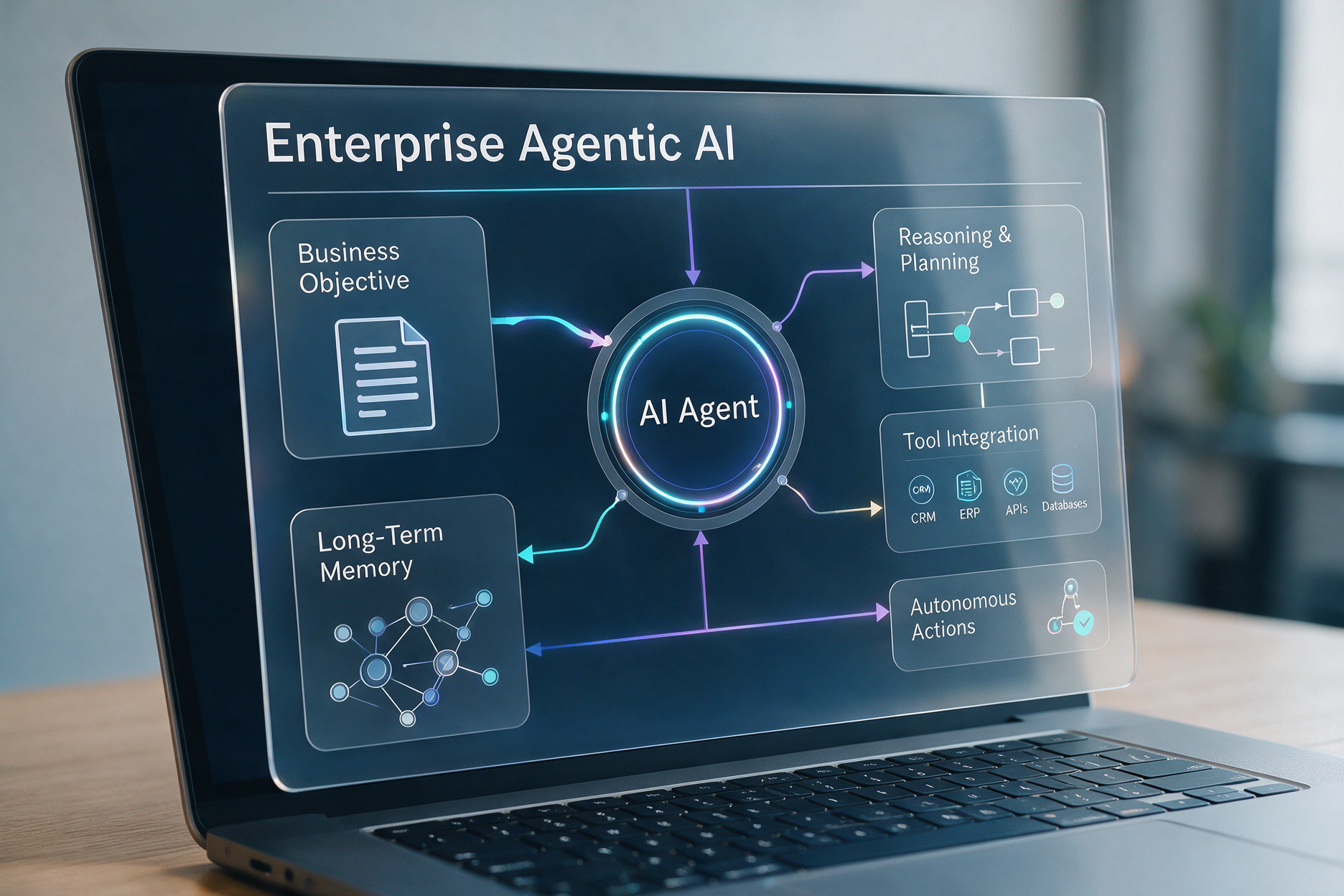
To operate reliably within enterprise environments, Agentic AI architecture rests on three engineering pillars:
- Reasoning & Planning: Instead of predicting the next word, agents decompose high-level business objectives (e.g., "Optimize Q3 logistics route costs") into structured sub-tasks.
- Tool Integration: Agents interface with enterprise infrastructure—executing API calls, running database scripts, web scraping, and triggering actions inside CRMs or ERPs.
- Dynamic Long-Term Memory: Agents maintain contextual state over extended workflows, learning from past operational failures and refining strategies over time.
Enterprise Agentic AI Use Cases: DevOps, Supply Chain, and Customer Success
At Everestek, we see Agentic AI as the engine behind the next wave of digital transformation. Here is how it is being applied across industries:
- Claims Management: AI Agents autonomously handle the end-to-end claims lifecycle. The process begins with the AI reading and interpreting the policy details of the insured. It then thoroughly investigates and cross-references all supporting documents shared during the claim process (e.g., reports, statements). Finally, the agent summarizes all critical findings, compares them against policy coverage, and provides a documented verdict or recommendation for claim resolution.
- Advanced Marketing and Sales Automation: An AI Agent functions as a proactive market intelligence and campaign deployment system. Based on specified targeting criteria or existing customer information, the agent autonomously identifies relevant companies and key personnel to target. It then designs and creates a personalized email sequence, and automatically initiates the campaigns, managing deployment and tracking performance.
- Insurtech Chatbot for Knowledge & Support: This specialized AI solution serves as both a comprehensive knowledge base and the primary first-line support provider within the insurtech domain. It can address customer inquiries regarding policy details and pricing. Furthermore, it operates as a tool for internal agents, providing predictive support for complex tasks like commissions forecasting.
- Self-Healing DevOps: Beyond simple monitoring, AI agents can detect a server anomaly, analyze the logs, search for a patch, and deploy a fix all while notifying the human lead of the resolution.
- Hyper-Personalized Customer Success: Imagine an agent that doesn't just answer a customer’s billing question but proactively identifies a better subscription plan for them, asks if they’d like to switch, and updates the contract in the backend automatically.
- Supply Chain Orchestration: Agentic AI can monitor global shipping delays in real-time. If a delay is detected, the agent can automatically re-route cargo, update inventory levels, and notify stakeholders without a human ever touching a keyboard.
The ROI of Autonomy: Why Agentic AI Beats Passive Intelligence
The transition to Agentic AI isn't just a technical upgrade; it’s a strategic one. Businesses in 2026 will be defined by their "agentic workflows." Companies that rely on human-in-the-loop for every minor decision will struggle to keep pace with "Autonomous Enterprises" that leverage agents to handle the high-volume, high-complexity tasks that typically cause bottlenecks.
However, autonomy requires governance. Implementing Agentic AI means building robust guardrails to ensure these agents operate within ethical, secure, and compliant boundaries.
Conclusion: Preparing for the Autonomous Enterprise
The era of the "prompt" is giving way to the era of the "objective". AI is evolving from a software tool into an autonomous enterprise partner.
The winning enterprises in 2026 won't just be those using AI for drafting text; they will be those giving intelligent agents the governed autonomy to execute business processes.
Ready to Transition to Agentic Workflows?
Deploying autonomous, goal-driven agents requires careful architecture, governance, and system integration.
Talk to an Everestek AI Architect Today to evaluate your readiness and design enterprise-grade, governed AI agent workflows.
